NEW YORK — American farmers, chemical companies and other exporters of agricultural products are hoping to move on from a year that saw them put squarely in the geopolitical crosshairs.
President Donald Trump’s peripatetic tariffs, trade wars and maritime policies put producers not only at a competitive disadvantage in world markets, but for a time threatened to make it unprofitable to even load a ship.
“If you’re in trade and transportation, what do you really need?” asked Peter Friedmann, executive director of the Agriculture Transportation Coalition (AgTC), addressing a seminar of the Traffic Club of New York Nov. 25. “You need trucks, and you need ships and trains. But, that’s not the first thing you need. You need cargo. If the cargo isn’t coming because of trade battles or tariffs and so forth, that doesn’t matter how nice your trucking fleet is, or how great your service is.
“There’s got to be the cargo.”
Friedmann said that his group’s top priority is to keep cargo moving amid “self-inflicted wounds” that need to be addressed.
“As far as tariffs, our trading partners are always going to find other places to get the products that we want to send them,” Friedmann said. “There’s nothing we produce in this country that cannot be sourced somewhere else in the world.”
Friedmann pointed to market shifts even for products that had long-established U.S. sourcing, such as almonds from California, and how those shifts ripple through the supply chain.
“I was just told by our biggest exporter that you can get just as good [almonds] from Australia. And Australia has a trade agreement with India giving their growers preferential access. That’s cargo that used to be going from California by truck to be handled by stevedores at the port of Oakland or the port of Los Angeles, getting on a ship and going all the way to India. Now, it’s coming from Australia and it’s going to India.”
It’s said that when transportation makes headlines, it’s rarely good news. So it’s likely few consumers had a China boycott of U.S. soybeans on their bingo card in 2025 — retaliation for Washington’s tariffs on a wide range of Chinese products.
A ceasefire in the trans-Pacific trade war saw China resume purchases of U.S. soybeans. But Friedmann observed that tariffs masked structural issues that will continue to threaten the viability of American exports: Beijing shifted soybean purchases to Brazil, where each year hundreds of thousands of acres of rainforest are converted to farmland. At the same time, China has developed its own crop.
“The number one consumer of soybeans in the world is China,” he said, “and the number one producer of soybeans in the world is China.”
Friedmann would not predict how the Supreme Court would rule on a challenge to the legality of Trump’s tariffs. Refunds in the tens of billions of dollars hang in the balance — a situation that is “going to be a little bit of a ‘cluster’ for exporters.
Friedmann also addressed the Trump administration’s since-paused port fees on Chinese vessels meant to blunt Beijing’s maritime dominance and kickstart a revitalization of American shipbuilding.
The bipartisan “stupid, brain-dead idea” originated by the Biden administration and implemented by Trump, “is to promote your shipyards by making it very expensive to ship on a Chinese-built or -owned ship,” since China now builds more close to half of all cargo vessels.
But there was a catch.
“U.S. shipyards have never built a container ship, such as typically transit the Atlantic and Pacific, of 7,000 TEUs (twenty foot equivalent units) up to 20,000 TEUs,” said Friedmann. “The largest we’ve ever built-in this country was a container ship of 3,400 TEUs and that was done under the protection of the Jones Act,” for services between U.S. ports.
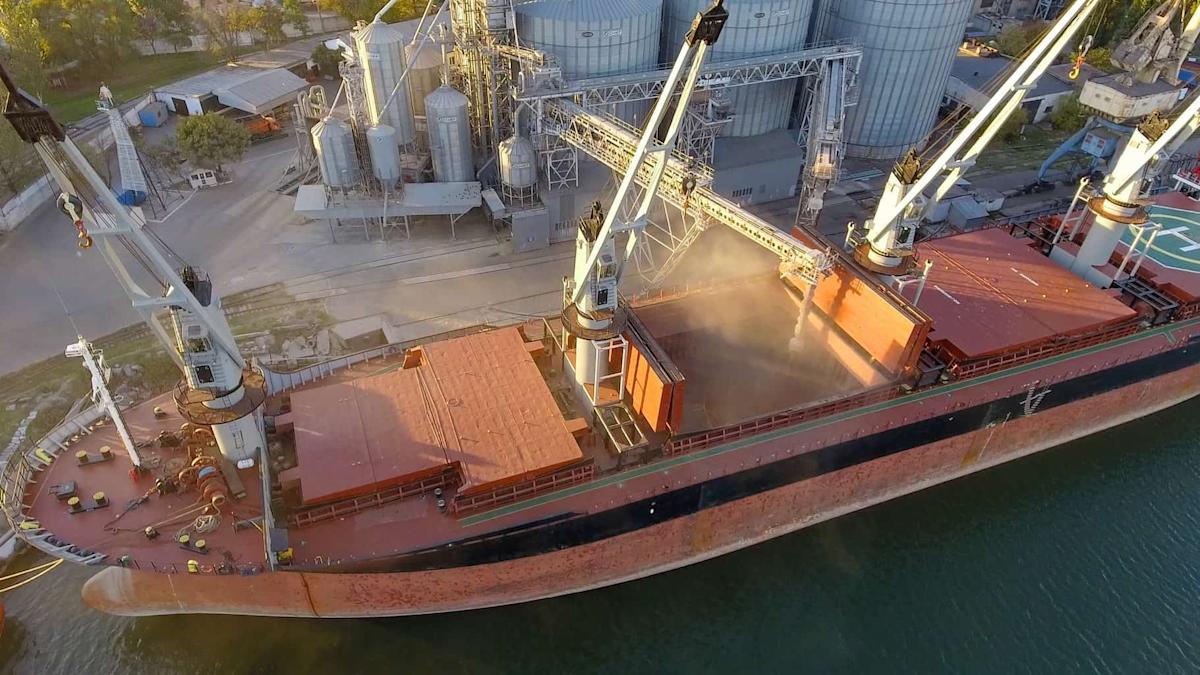
The same applies to large bulk vessels typically used to move ag products.
The initiative offered no reasonable alternatives for U.S. ag exporters who suddenly found the use of Chinese ships prohibitively expensive.
Friedmann credited a unified front by importers, exporters, carriers and truckers for first extracting an exemption on empty ships for export loading and later, helping to get Trump to suspend the port fees, scheduled to go into effect Oct. 14, for one year.
“But this was bipartisan idiocy, and unfortunately, we’re not out of it yet. That it’s suspended means it’s on the books, so if nobody does anything, it automatically goes into effect next October. So, more for us to work on together.”
Friedmann also called for increased federal weight limits for trucks.
“We have the lowest truck weight limits in the world. Our truck weight limit is 80,000 pounds gross vehicle weight. In Canada, it’s 105,500 pounds and in Europe, it’s 105,000 pounds or higher. Which means for every one truck that they can send to the port in Canada, France, Sweden, Denmark, or Germany, we have to send two trucks that carry the same amount of cargo. That’s two trucks, two drivers. We have to send twice as many to get the same amount of cargo to the ports and from the ports inland.”
Friedman said that as far as safety, a truck with a three-axle trailer and 105,000-pound GVW actually puts less weight per axle on the roadway than a twin-axle trailer of 80,000 pound GVW.
Friedmann said that U.S. railroads have been effective lobbying Congress against raising truck weights on interstate highways, although some states allow higher GVS in specific cases. Washington state has the highest limit at 105,500 pounds, but those truckers face a regulatory wall when they reach the border of a state such as California with a lower limit.
At the same time, federal regulators are preparing to evaluate the proposed merger of Union Pacific (NYSE: UNP) and Norfolk Southern (NYSE: NSC), an historic tie-up that if approved would create the first freight-only transcontinental railroad.
“Conceptually, it sounds good,” Friedmann said, adding that not all rail shippers are sold on the idea. “That’s a big question for this industry as a single transcontinental railroad changes the dynamic of everything you do.”
The effects could reach far down the supply chain.
“You think you might be just local drayage, but [the merger] will make a difference if that cargo is no longer coming to your port and is going to another port that Norfolk Southern prefers. But, that doesn’t mean a transcontinental railroad won’t change the routing of cargo, and might bring you more.”
Another self-inflicted wound: Powerful labor unions barring the full implementation of automated cargo-handling technology at ports.
“If we ban automation of marine terminals, then we do it knowing that there’s going to be something else we have to do to make up for that loss of efficiency.”
Friedmann told the seminar that operating ports on the East Coast have an advantage over landlord ports on the West Coast.
“On the West Coast, where it’s all private terminals, the port executive director can have all sorts of bright ideas, but he can’t implement them.”
Something else to watch, Friedmann warned, is what he termed a “war against independent contractors”.
“It started in California and applies not only to trucking, but across-the-board, because if you’re an independent contractor you can’t form a labor union. But if you’re an employee, employees can form labor unions. And they’re pulling the chain of all the legislators.”
He said New Jersey, Oregon and Washington are following California’s lead; a reclassification of employees could increase costs 20-25% for an organization.
“Who’s going to pay for that, the cargo, right?” Friedmann said.
In related issues, Friedmann said trucking capacity could be affected by the Department of Transportation’s efforts to eliminate state-issued non-domiciled commercial drivers licenses as well as non-English speaking drivers.
He added that carriers and shippers need to work together to fight the growing crisis of cargo theft. All it takes is a tampered seal for a consignee to reject a container loaded with agricultural or perishable products.
Find more articles by Stuart Chirls here.
Related coverage:
Emergent Cold LatAm opens state-of-the-art cold storage hub in Guadalajara
Costco sues Trump administration as tariff backlash intensifies
DHL partners with Happy Robot for AI-efficient operations
Auto parts, berries and lettuce used to smuggle millions in drugs
The post US ag exporters hoping to move on from 2025’s ‘self-inflicted wounds’ appeared first on FreightWaves.


Leave a Comment
Your email address will not be published. Required fields are marked *