
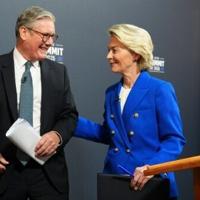

Britain’s so-called Brexit wars dominated parliament for years. Now the Labour government is bracing for new battles as it eyes legislation to move closer to the European Union.
Prime Minister Keir Starmer immediately set about repairing and rebuilding relations with the 27-member bloc after winning the July 2024 election that ousted the Conservatives after 14 years in power.
He hopes a deeper relationship with European neighbours can help fire up Britain’s insipid economy and inject life into a premiership that has so far been deeply unpopular with the public.
His Labour government is preparing to introduce a bill that would provide a legal framework for his much-touted “reset” of relations with the EU.
Despite Labour’s crushing majority in parliament, the move is expected to be fiercely opposed by the right-wing opposition parties — the Conservatives, who took Britain out of the EU, and hard-right Reform UK, which leads opinion polls.
“Bring it on,” a UK government official told AFP, referring to likely “Brexit betrayal” claims from the Tories and Reform’s leader, arch-Eurosceptic Nigel Farage.
The move also risks splitting open divisions within Labour, including over whether the party should breach a manifesto promise not to rejoin the EU customs union.
Last year, Starmer struck an economic agreement with EU leaders that aims to boost trade by easing red tape on food and plant exports.
They also agreed to work on a new electricity deal that would integrate the UK into the EU’s internal electricity market, with the intention of lowering energy costs.
– ‘Brexit damage’ –
The agreements form part of Britain aligning itself with EU rules in certain areas.
The bill has not been published yet but the government official, who asked not to be named, said it would provide a “mechanism” for an alignment.
“The bill will provide the powers to adopt the rules and set out the role parliament will play in that,” the official said.
The government hopes to introduce the legislation in the spring or summer, meaning it could coincide with the 10th anniversary of the Brexit referendum, which was held in June 2016.
Three years of bitter parliamentary wrangling about what Britain’s relationship with the EU should look like post-departure followed the vote, ultimately leading to the resignation of Theresa May as prime minister.
The deadlock was broken when her successor, Boris Johnson, won a landslide general election victory in December 2019 to force through the exit.
Opinion polls regularly now show that most Britons regret the razor-thin vote to leave the EU and view the Brexit project as a failure, something Starmer hopes can work in his favour.
“Labour members are almost wholly united in wanting to see some of the damage done by the Tory-Farage Brexit exposed and fixed,” said one supportive Labour MP.
“Closer alignment helps our economic message, has the backing of members and most MPs, and will provide a boost to British business,” the lawmaker, who asked not to be named, told AFP.
But not all Labour MPs are in agreement.
Thirteen of them recently voted in favour of a bill by the pro-EU centrist Liberal Democrat party that called for the UK to begin negotiations to rejoin a customs union with the EU.
– ‘Do more’ –
Health Secretary Wes Streeting, widely seen as the favourite to succeed Starmer as Labour’s next leader, has indicated his support for such an agreement.
Starmer has come out against a customs union, however, insisting that he favours closer realignment with the EU’s single market.
“I want us to do more,” one Labour MP who feels Starmer is not being bold enough told AFP on condition of anonymity.
Other Labour lawmakers would rather he left the issue alone.
“We said we wouldn’t re-open the Brexit debate and now we are doing exactly that,” MP Jonathan Hinder told AFP.
“We can create a fairer, socialist Britain while outside the EU and that is what we should be focused on doing.”
A UK government spokesperson said in a statement that the reset was “improving our diplomatic, economic and security cooperation and will be worth £9.0 billion ($12 billion) to the UK economy by 2040”.
“We will legislate to deliver on this and further details of the bill will be announced in due course.”
The deputy director for the Centre for European Reform think tank, Ian Bond, said that whether the bill is “a game changer will depend on exactly how much latitude the British government gives itself”.
“If it holds its nerve, it really doesn’t need to pay any attention to these noises,” he said.
But he added he felt ministers were “all terrified that if they do anything too bold, Reform will criticise them for it”.
pdh-mhc/jkb/gil/jhb