
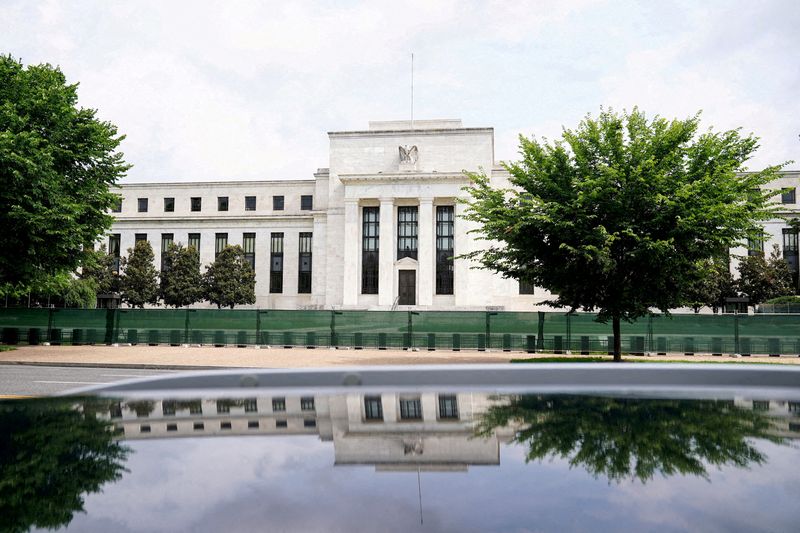

Fed data suggests central bank has stopped losing money
By Michael S. Derby
Dec 3 (Reuters) – The Federal Reserve appears to have finally turned the corner on a three-year-long string of unprecedented loss-making tied to how it has implemented monetary policy in the wake of the COVID-19 pandemic.
Over recent weeks, data released by the central bank shows that since the start of November the Fed has started to make enough money again to very slowly start covering an accounting mechanism it uses to capture its losses.
Since November 5, the size of the Fed’s so-called deferred asset has gotten smaller, moving from $243.8 billion to $243.2 billion on November 26. It’s a small change, but it’s also a clear shift in a long-term trend.
Fed watchers do not know how long it will take for the Fed to cover its deferred asset and again return cash to the Treasury, but they suspect that effort will be measured in years.
Bill Nelson, a former top Fed staffer who is now chief economist for lobbying group the Bank Policy Institute, said that by tracking the financial performance of the regional Fed banks, the Fed “appears to be on track for the combined profits of the 12 Reserve Banks to be over $2 billion in the current quarter.”
The Fed’s deferred asset tallies up losses that must be covered before the Fed can again return its profits to the Treasury, as it is required to do by law. The Fed funds its operations through income it earns from its bond holdings and from services it provides to the financial sector. Whatever is left over is then handed back to the Treasury.
That setup has for most of the Fed’s modern history made it a steady source of income for the rest of the government. But that changed during the pandemic, which ultimately led the Fed to begin to lose money in September 2022.
PANDEMIC BOND-BUYING SPREE
To help stabilize the financial system and provide additional economic stimulus, the Fed bought Treasury and mortgage bonds to depress longer-term borrowing costs. That more than doubled the size of Fed holdings to a peak of $9 trillion by the summer of 2022.
The challenge for the Fed emerged in the same year its bond holdings topped out. Surging inflation pressures caused the Fed to sharply raise rates starting in early 2022. That generated a rising mismatch in the income the Fed was making relative to what it needed to pay out to banks to manage interest rates.
Rate cuts have largely halted the Fed’s loss-making, which means it has been paying out less to banks to maintain the federal funds target rate range, which now stands at between 3.75% and 4%, after hitting between 5.25% to 5.5% in 2023. More rate cuts likely lie ahead for the Fed as officials worry about the state of the job market.
Leave a Comment
Your email address will not be published. Required fields are marked *