Hong Kong’s Deadly Fire Triggers Rare Public Outrage
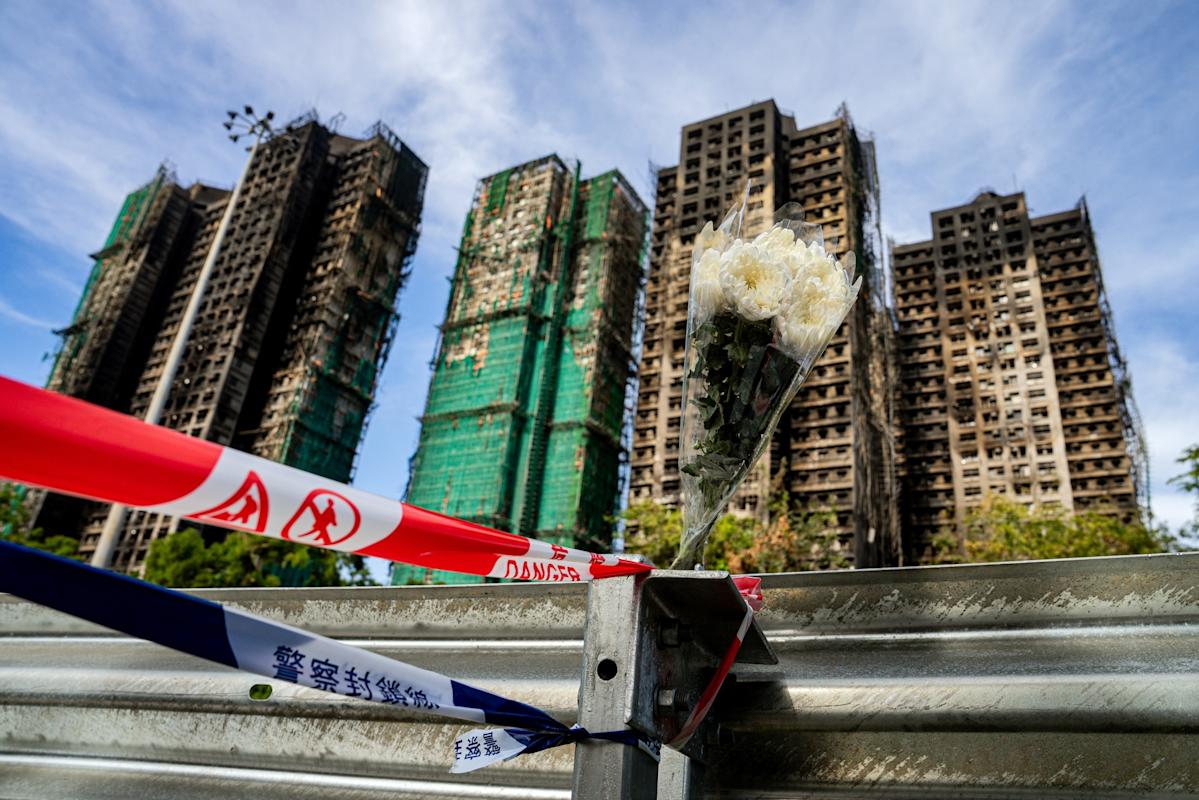
Floral tributes for victims of the fire at Wang Fuk Court residential estate left on a barrier in Tai Po district in Hong Kong, China, on Friday, Nov. 28, 2025.
(Bloomberg) — Never miss an episode. Follow The Big Take Asia podcast today.
Hong Kong’s worst fire disaster in decades has stirred up public anger over negligence, safety standards and official accountability.
Most Read from Bloomberg
On today’s Big Take Asia podcast, host K. Oanh Ha talks to Bloomberg’s Shawna Kwan and Jenni Marsh about the devastation, the political fallout and how the public outcry is causing unease in Beijing.
Terminal clients: Click here to subscribe
Here is a lightly edited transcript of the conversation:
Andrew Leung: This is painful for me. I feel helpless. How could such a massive fire happen? And this could have been prevented.
K. Oanh Ha: For the past few years, Andrew Leung has lived with his elderly mother at Wang Fuk Court, the site of last week’s devastating fire here in Hong Kong.
Ha: More than 150 people were killed and many others – including Andrew and his mother – were displaced after the blaze ripped through the housing complex, damaging seven of its eight towers.
Over the weekend, thousands of mourners from across the city gathered at the site to honor the victims. At one point, the line stretched for more than a mile. They left handwritten notes and bouquets of white and yellow chrysanthemums, a flower traditionally used at funerals here.
Across the city, the sense of shock, anger and sadness is palpable. When I visited Wang Fuk Court with our producer last week, the elevated walkways and sidewalks were lined with people. They just stood in silent disbelief, staring at the burnt shell of the housing complex. Nearby, thousands of volunteers disbursed supplies to victims – a mass mobilization not seen in years.
We met Andrew and others like him – residents struggling to make sense of the devastation before them.
Wang Fuk Court resident: My cat died in the fire and I cried for two days. I saw my own house burn down, but what can I do?
Ha: The Hong Kong government has opened an investigation into what caused the fire. But many questions are still to be answered – why the building’s fire alarms failed, and whether the contractor renovating the complex followed proper safety protocols.
Shawna Kwan: I think the public really wants to know whether the contractor is at fault and whether the authorities have any chance to have stopped it, but it didn’t.
Ha: Shawna Kwan is a Bloomberg real estate reporter based in Hong Kong
Kwan: All these are the answers the public are urgently seeking.
Ha: This kind of outpouring of grief and mounting anger hasn’t been seen in the city since 2020, when Beijing imposed its national security law here. Authorities in Hong Kong have moved quickly to forestall any potential unrest: China’s national security office in the territory issued a stark warning, saying it will take action against anyone attempting to stir up unrest or threaten national security.
Over the weekend, at least three people were arrested, for sedition and inciting hatred toward the government.
Jenni Marsh: They’re coming down hard and quick because they do not want this to snowball.
Ha: That’s Bloomberg’s Jenni Marsh, who oversees our coverage of Greater China’s economy and politics. I spoke with Shawna and Jenni to understand how this tragedy unfolded, how the fire became entangled with the national security law, and how the government is using that law to keep order.
Marsh: They’re concerned that public grief and mourning will get out of their control. And they do not want protests. They don’t want Hong Kong to look disorderly.
Ha: This is the Big Take Asia from Bloomberg News. I’m Oanh Ha. Today on the show — Hong Kong’s deadliest fire in decades – the fury it’s ignited in the financial hub, how that’s causing unease in Beijing, and what this could mean for Hong Kong’s future.
The death toll continues to rise in Hong Kong’s worst fire in nearly 80 years. Victims are still being identified in the ruins of the high-rise complex, with dozens still missing and thousands displaced. Like many of us across the city, Bloomberg real estate reporter Shawna Kwan watched in horror as the flames tore through the massive housing complex in the northern district of Tai Po last week.
Kwan: So on Wednesday, November 26, a fire began at around 3 p.m. at one of the buildings at the Wang Fuk Court complex and it spread quickly to the other six towers in the densely built high rise complex within just a couple of hours. So a total of seven out of the eight tower complexes were affected. There was a massive rescue effort, close to 400 fire engines, 2,300 firefighters and paramedics but the fire was not contained until about 40 hours later on Friday morning.
Ha: Now Shawna, for people who aren’t here in Hong Kong, I wonder if you can give us a bit of background about Wang Fuk Court. Where is it in Hong Kong? What kind of housing is it? Who lived there?
Kwan: It was built in the 1980s as government subsidized housing – so to the growing lower middle-class buyers at discounted prices. It consists of eight blocks with almost 2,000 apartments. I suppose, you know, in international standard that’s quite compact and dense, but it’s very typical in Hong Kong because home prices are so expensive in Hong Kong, it’s normal for families to live together and for buildings to be built very close with each other.
Ha: Hong Kong’s limited land and high density make it difficult to demolish and rebuild aging buildings. Individual owners are often responsible for maintenance. By law, private buildings over three stories and more than 30 years old must undergo mandatory inspections and renovations. Around 29,000 buildings — that’s roughly 60% of the city’s total — have reached that threshold, and thousands more will join over the next decade.
When the fire broke out last week, Wang Fuk Court was about a year into a 41 million dollar renovation project to repair damage to its exterior walls.
Ha: Shawna, this kind of renovation is pretty common here in Hong Kong. It’s part of the everyday scenery here for us.
Kwan: Yeah.
Ha: But for people who aren’t familiar, can you describe what construction on high rises look like here in Hong Kong?
Kwan: Yeah, it might be quite a strange visual for our international readers. So when you walk around Hong Kong, you may see high rises as high as 40, 30 or even higher floors, have bamboo scaffolding wrapped around it, and on top of it, usually green netting as well. So when those renovation projects are ongoing, the residents inside, sometimes they cannot even open the windows and sometimes you cannot really see what’s going on outside from the apartment. So that might have contributed to the tragedy as well because the victims might not have known what’s happening outside.
Ha: Yeah. They might not have seen a fire and flames spread outside their windows, right?
Kwan: Yeah.
Ha: There were warnings about problems with the Wang Fuk Court renovation from the outset. Initial findings revealed that the protective nets and foam panels used during the renovation may have failed to meet fire safety standards. And that may have been a factor in how quickly the blaze spread.
Residents of the towers told Bloomberg they raised concerns about the plan to put styrofoam boards over the windows more than a year ago. According to several attendees, a representative for the consultancy overseeing the renovations brushed off their concerns, saying that styrofoam wasn’t illegal. Here’s Bloomberg’s Jenni Marsh:
Marsh: They knew that the construction materials that had been put up around their building, they knew that these materials were no good. They had tested them themselves. They knew that they were flammable and they tried at every single turn to raise the alarm in every single way they knew possible. These residents didn’t just complain to the construction company, they went to the labor department, they went to the housing department, they went on television. The labor department visited 16 times. Did they not see there were styrofoam boards in people’s windows? And no one did anything to protect them, and I think that is what has made people here so angry.
Ha: Bloomberg’s reporting showed a series of missed opportunities to prevent the tragedy – from home-owner concerns that weren’t addressed to an appeal to the anti-corruption agency to investigate the contractor.
Then there’s Hong Kong’s use of traditional bamboo scaffolding, which has become a flashpoint.
Kwan: Bamboo scaffolding has been such an integral part of Hong Kong’s landscape as well as architectural culture. It has been here for over a hundred years. So using bamboo, which is lighter as well as cheaper and more agile, as opposed to metal which is fixed.
Ha: Hong Kong is one of the few places in the world that routinely uses bamboo scaffolding in construction. China banned its use for residential and municipal construction a few years ago.
Kwan: So when I talk to experts, they say that obviously bamboo can be burned, but it’s not easy to burn. And obviously metal is more durable than bamboo is. But as more investigation went on and in the later press briefings, government officials said that it was probably the netting that first caught fire and the rapid spread of fire was mainly because of the foam panels.
Ha: In the aftermath of the fire, the government announced that it would accelerate phasing out bamboo scaffolding and replacing it with metal alternatives for safety. That’s a big shift from an earlier plan, which aimed to replace bamboo in about half of public construction projects.
And with the public calling for investigations and accountability, the government has taken swift action.
Kwan: So very quickly the government carried out an investigation and overnight they arrested three people from the contractor company for manslaughter and the anti-corruption watchdog had also arrested eight people connected to the project. The three people arrested by the police were two directors of the company and one engineer for the contractor. And the eight people arrested by ICAC – the anti-corruption watchdog in Hong Kong – are relatively unknown. There were concerns from the residents about the projects ultimately being awarded to the most expensive bidder. For the Wang Fuk Court, the price tag for that project was HK$330 million. So you can tell how lucrative this industry is.
Ha: Since those early arrests, authorities said they’ve apprehended more individuals.
After the break, the tragic fire has triggered memories of the divisive protests that rocked the city in 2019. How the national security law is being used to stamp out mounting anger and what this moment reveals about Beijing’s tightening grip on the city.
One of the most pressing demands from the public is for the government to launch an independent inquiry. On Tuesday Chief Executive John Lee announced plans for an independent committee to investigate – but it’s not certain it will appease the public calls for a thorough investigation. The committee relies on voluntary participation and testimony isn’t given under oath.
Amid the calls for transparency, another issue that’s come into the spotlight are the other arrests authorities have made that are not connected to the construction project. Bloomberg’s Jenni Marsh says some of the anger and public calls for accountability have caught the attention of authorities.
Marsh: So the anger that we talked about started to find a sort of organized expression over the weekend. On Friday there was an Instagram account that popped up – a Tai Po residence sort of concern group – and it made four demands from the government. One of them was an independent inquiry. That was quickly taken down. We don’t know under what circumstances. But there was a student called Miles Kwan who then was sort of handing out leaflets with these four demands on. And he has been arrested for sedition. Another arrest was a former district counselor Kenneth Cheung. And he again, he was posting a lot on social media. He said these volunteers in Tai Po around the sports center had formed a human chain passing sort of along materials to give to the survivors of the blaze. And to him that the feeling of sort of people coming together en masse on the streets for a cause, and a cause, which you know is holding the government to account, he was saying this reminds him of 2019.
Ha: In 2019, anti-government protests rocked Hong Kong. Millions of demonstrators turned out to protest, with many camping out on the street for months. Volunteers formed long human chains across the city, handing out supplies to protesters, from water and food to hard hats and gas masks. Jenni says for the government, just evoking memories of those protests could threaten the city’s stability.
Marsh: So the government, on the one hand is suspicious of this feeling like the protest movement, but the people out on the streets themselves are recognizing there hasn’t been anything like this since 2019 when people back then were very angry against the government, came out en masse, made five demands, and one of them was, you know, a government inquiry. So different circumstances completely. But the parallels are emerging and I think it’s a test of the government, how they handle this kind of mourning in this sort of new national security environment.
Ha: I was out in Tai Po this weekend. And what really struck me was the anger and frustration that I felt from the people that we spoke to. It feels very different from the way Hong Kong felt just even a week ago.
Marsh: Yeah. I think the tragedy has really sort of pierced the calm that had come over Hong Kong since Beijing imposed the national security law in 2020. You know, this is a complex of high-rise blocks that people saw go up in flames and most people in Hong Kong live in a tower that looks a lot like this. And I think everyone realized it could be them.
Ha: The fact that the government is moving to arrest people under national security law because they’re asking for accountability – what is it that is threatening to the government? What is it that they’re really concerned about?
Marsh: They’re concerned that public grief and mourning will get out of their control. They have people coming together on the streets with a lot of emotion and anger, and they do not want protests. They don’t want Hong Kong to look disorderly. John Lee is a former police officer. He was hired to get the city under control, and that’s what he’s done. Like since he’s been in power, there has not been any protest. I think there was one small protest over a housing issue in northern Hong Kong a year or so ago, and all those involved had to apply to be in the protest that they had numbers, like they were in a marathon that were given out from the police. It’s been that controlled, it’s more controlled here than in mainland China. John Lee doesn’t want Xi Jinping looking down and thinking that he’s let it all slip away from him and it’s got out of his control again. That’s not the message they want to send.
Ha: Chief Executive John Lee this week said that all of Hong Kong is uniting to help those affected by the fire. He also warned those who “dare to sabotage this commitment to society,” saying that authorities will take action to ensure justice.
Marsh: They’re coming down hard and quick because they do not want this to snowball.
Ha: China is just right next door and watching all of this. I mean, hours after the fire broke out, Chinese President Xi Jinping expressed sympathy to the families of the victims. He urged efforts, you know, to extinguish the fire. And Beijing also dispatched a central task force to Hong Kong for emergency response. It seems that Beijing has been more hands-on with this disaster in Hong Kong. How has that been received by locals and why is that significant?
Marsh: It was surprising the speed at which Xi Jinping came out. On the mainland he often isn’t very swift to respond to tragedies in that way. So it stood out. I think it told Hong Kong that the government in China is watching. That they have their support in terms of if you need backup resources, they have it. But I think it also isn’t a very clear message to the political leaders in, in Hong Kong, that this was important to the central authorities. That it was important to handle this correctly. They really want Hong Kong leaders to sort of make this a successful financial hub, to manage the city’s image properly, to make it attractive. And the sad thing about this too is from a global perspective, Hong Kong is back in the news for all the wrong reasons, again.
Ha: Here in Hong Kong, we’re now living under this new national security environment and China’s tighter grip on the city. What does the government’s response to the tragedy tell us about where we are right now?
Marsh: It sort of leaves Hong Kong in my mind, in this halfway house, you know, where like John Lee is trying to be open. He’s briefing, he’s out there meeting people. It’s all a contrast with how this would be on the mainland when tragedies like this happen. There was a car ramming last year where about 40 people died. In the mainland that kind of thing is censored very quickly. People laid out flowers that were swept away almost immediately. There’s no outlet. There’s nowhere people can sort of vent that public grief because it’s too dangerous in the eyes of the Communist Party to let people come together like that and start to ask questions about why did this happen? Hong Kong isn’t, isn’t at that point. We don’t have that kind of censorship apparatus. We’re a long way from it. That’s gonna be one of the interesting things. Does John Lee open an independent inquiry? I think if he does, there’ll be a lot of applause and it will show that the government is willing to be open about this. But I think he has to weigh the risk. You know, if there’s a public inquiry and it finds the government was guilty, then what’s the risk in that? I think we have to wait and see how, how China thinks John Lee handles this and it will depend on what happens in the coming sort of days and weeks. He needs to handle it in a way where he doesn’t come down too hard and then create even more anger that then sort of boomerangs back at the government.



Leave a Comment
Your email address will not be published. Required fields are marked *