

How can we decarbonise shipping without damaging the global economy?
Shipping plays a key role in our economy, with almost 50% of goods traded between the EU and non-EU countries being transported by sea, according to 2024 data.
That role is only growing, with data suggesting that the share of goods transported by sea rose by nine percentage points for imports and by over four points for exports between 2002 and 2023.
But with the UN’s International Maritime Organisation (IMO) trying to introduce a levy on carbon emissions from shipping, is the industry ready to reduce its impact or face rising costs?
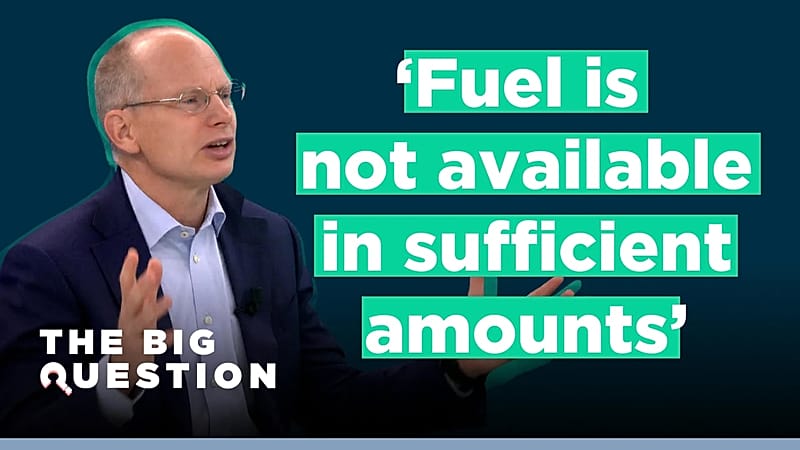
In this episode of The Big Question, Eleanor Butler is joined by Håkan Agnevall, CEO of Wärtsilä, to discuss the importance of the shipping industry and how to make it more sustainable.
One of the world’s most famous shipping routes is the Suez Canal. Built in the late 19th century, the artificial waterway bypasses the Horn of Africa and reduces shipping time, cost and emissions between Asia and Europe.
“In 2021 we had this big container vessel, Ever Given, it got stuck in the Suez Canal. The estimates are that every day the cost for the global economy of the Suez Canal being shut down was €10 billion,” Håkan told The Big Question.
According to the OECD, over 80% of global goods are transported by sea. Between 1995-2020, 22.8 million people were employed on average through maritime industries such as shipbuilding, equipment manufacturing, and maritime R&D.
Through shipping’s wider impact on the economy, Håkan estimated that 1 in 5 jobs in Europe depend on the export industry.
Related
Currently, the shipping industry accounts for around 2-3% of global CO2 emissions. That’s roughly the same as the aviation industry, or Japan — the world’s 5th largest polluter.
As governments and global regulators, like the IMO, work to set new frameworks and emissions targets for the industry, shipping companies are looking for ways to adapt.
“There are about 100,000 large vessels out there in the world and we cannot just scrap them,” Håkan explained.
To reduce the emissions of the existing global fleet, Wärtsilä has developed a carbon capture technology which can extract around 70% of the CO2 from an engine’s exhaust.
Around half of today’s fleet is propelled by diesel, and 48% is prepared for alternative fuels. Håkan highlighted that liquified natural gas (LNG) is categorised as an alternative fuel, despite being a fossil fuel.

Leave a Comment
Your email address will not be published. Required fields are marked *