

Australia expands grain-fed beef exports as US production falters
By Peter Hobson
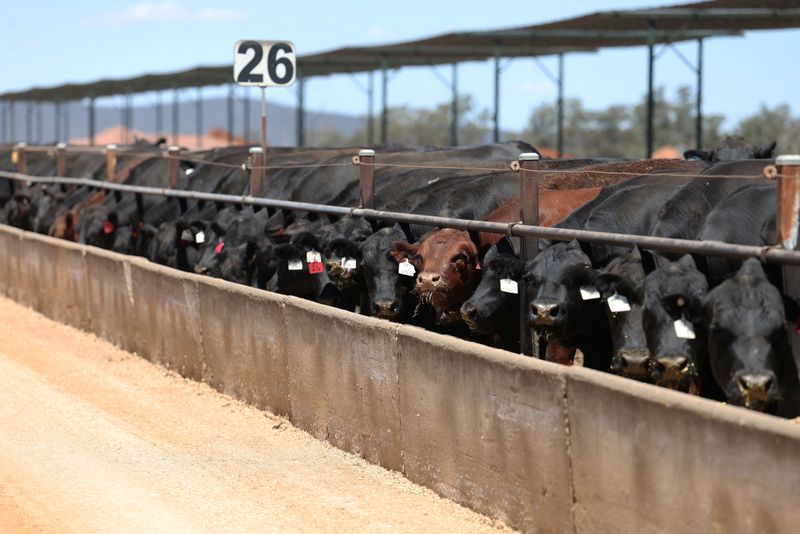
EUGOWRA, Australia, Dec 1 (Reuters) – Six thousand Black Angus cattle chew on rolled barley, silage, cottonseed and molasses, fattening up in three rows of shaded pens under the hot Australian sun.
After an average of 90 days at the Gundamain feedlot, their weight can increase as much as 50% to around 600 kg (1,323 lb), all to meet rising global demand for juicy grain-fed beef.
Gundamain is part of a structural change in the cattle industry in Australia, whose vast pasturelands and small population have made it the second-largest beef exporter, shipping meat worth $8.6 billion in the first nine months of this year, according to customs records.
The rise of feedlots is helping Australia supply beef more consistently for export and take market share from U.S. exporters in Asian countries that prefer grain-fed meat.
“We’re constantly being asked for product,” said Tess Herbert, whose family owns and runs Gundamain, around a four-hour drive west of Sydney.
The feedlot plans to double its capacity to 12,000 head in the coming years, she said. “If our supply chain is asking, we’re going to address that. And the only way to do so is by expanding.”
RAPID RISE OF GRAIN-FEEDING
The number of cattle on feed in Australia rose to a record 1.6 million at the end of June, up from 1 million five years ago, industry data show.
Analysts expect the number to be around 2 million by 2027, by which time around half the cattle in Australia will be passing through feedlots on their way to slaughter, up from around 40% now.
The growth coincides with a contraction in the United States, the pioneer of feedlots and biggest producer of grain-fed beef, where years of drought have reduced cattle numbers to their lowest level since the 1950s.
The United States on November 1 had 11.7 million cows on feed, 260,000 fewer than a year earlier and the lowest number in years, according to the U.S. Department of Agriculture, which expects U.S. beef production to decline this year and next year.
“An acceleration in demand has driven the growth,” said Grant Garey, president of the Australian Lot Feeders’ Association and manager of feedlots for Teys Australia, one of the country’s biggest beef producers.
“Reduced production from the U.S. is definitely playing a role in that,” he said.
Feedlots have been used in the United States for nearly a century to fill out cattle before slaughter. Energy-dense diets quickly create larger, fattier cuts that consumers find tastier and juicier.
Sales of Australian meat, seen as a close match for U.S. product, are expanding to Asian nations that prize grain-fed beef for its marbling and quality.
Leave a Comment
Your email address will not be published. Required fields are marked *