
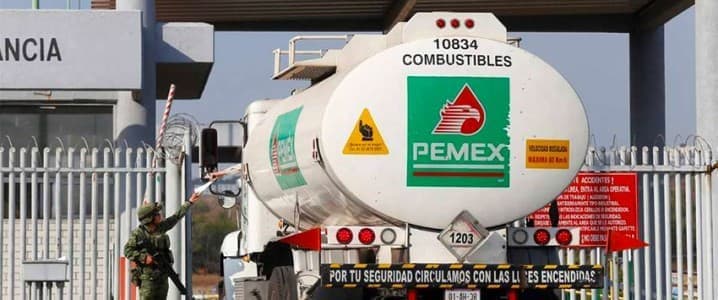

Pemex’s Debt Spiral Becomes a National Test for Mexico
Earlier this year, the Mexican government announced a special new financial instrument to help state-owned energy major Pemex with its debt repayment. The most indebted oil company in the world was in need of a unique solution to its problem—but this problem may be bigger than unpaid bills to suppliers.
In July this year, the Mexican government issued $12 billion worth of something called P-Caps. Normally used in corporate circles, P-Caps, or pre-capitalized securities, allow a borrower access to debt funding in case of need but without being included in its balance sheet. The securities sit in a trust to keep them separate from the company’s liabilities and avoid having them affect its credit rating.
The financial acrobatics were prompted by Pemex’s continued money troubles that have pushed its financial debt to $105 billion with another $20 billion in unpaid bills to suppliers. But those $12 billion in P-Caps were not enough. The government also set up a special investment vehicle worth $13 billion to fund Pemex’s operations with money raised from other investors. Per plans, the company should be able to turn things around by 2027. Based on Pemex’s track record, this would be quite a challenge.
The key to turning things around is better financial performance, and for this, Pemex needs to do better with oil and gas production. The Mexican state company is currently pumping around 1.6 million barrels of crude daily. It wants to boost that to at least 1.7 million barrels daily by 2033, as well as raising natural gas production by as much as 40% by that year.
Related: U.S. Waiver Lets Lukoil Stations Abroad Keep Operating Despite Sanctions
To do this, however, Pemex needs partners with deeper pockets than its own. It needs outside investors. The tricky part is that while it needs investors, the company—and the government that owns it—does not want to give those investors too much control over joint operations. As far as mixed signals go, this is among the more complicated ones.
One of the company’s ideas for reviving its output and boosting income, for instance, is reopening old wells. To do this, Pemex plans to partner with private firms through service contracts to tackle wells previously shut down due to high costs or technical challenges. Under the proposed model, private operators will bear upfront costs for engineering, operations, and maintenance, and receive remuneration tied to field performance under a negotiated tariff.
Another idea is for so-called mixed contracts with foreign partners for the development of fields that could, in theory, at least, add some 450,000 barrels to daily crude oil production, the Rio Times noted in a recent report on the situation with Pemex. Like the idle well reopening idea, this one is not really generous to those partners. Cost recovery is set at 30% before profits, and there is a condition that Pemex holds a stake of at least 40% in any such project.
Leave a Comment
Your email address will not be published. Required fields are marked *