These meticulous savers thought they could retire decades early — but soaring health-insurance costs are wrecking their plans
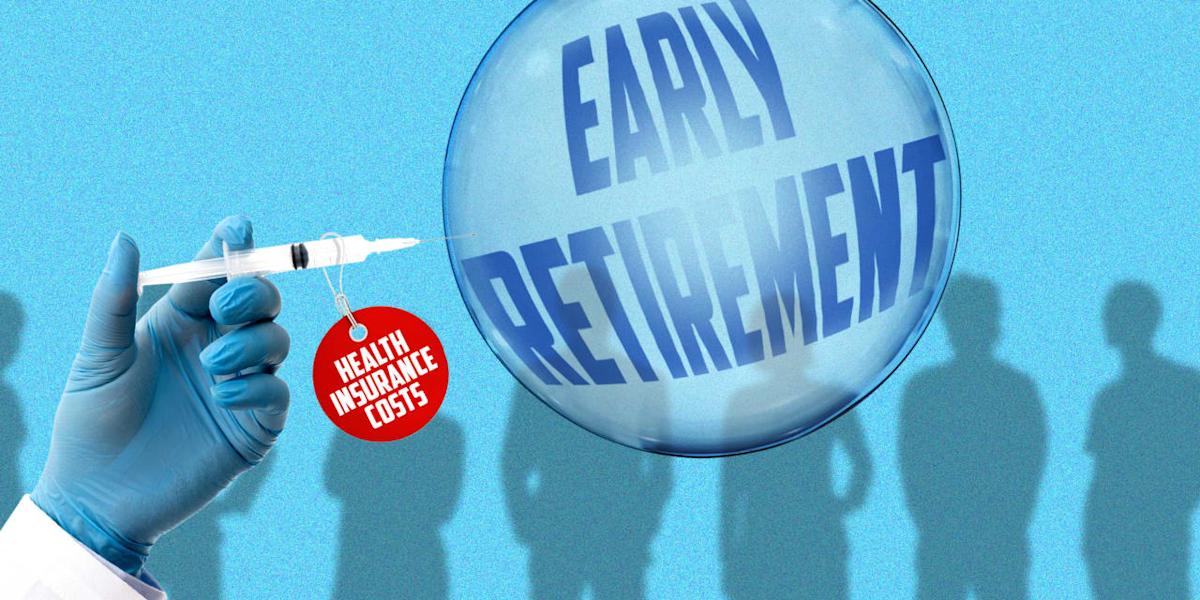
The amount that subsidized consumers pay for Affordable Care Act plans is expected to double on average next year, according to KFF. This means some people pursuing financial independence and early retirement, known as “FIRE,” will have to adjust their plans. – MarketWatch photo illustration/iStockphoto
For people pursuing financial independence and early retirement, commonly referred to as “FIRE,” health-insurance premiums are often among the top budgeting priorities.
This is especially the case now, as 2026 premiums for many are set to double after enhanced pandemic-era subsidies for Affordable Care Act marketplace plans expire — increasing the annual premiums some early retirees pay by thousands of dollars unless Congress votes this month to extend them beyond Dec. 31.
ACA, or Obamacare, plans are a critical option for people who are self-employed, contractors or between jobs. They are also popular among early retirees who lose access to employer-sponsored plans and don’t qualify for Medicare or Medicaid. More than 24 million people are enrolled in ACA plans, roughly 6% of the U.S. population.
With the expiration of the enhanced premium tax credits on top of a median proposed rate increase of 18% next year by insurers (the largest proposed hike since 2018), what subsidized consumers pay for ACA plans is expected to double on average, according to KFF, a health-policy research organization.
Most people who have “FIRE’d” will be impacted, “but the degree will vary by the person,” CJ Stermetz, a financial planner and founder of EquityFTW, told MarketWatch. “Sharply rising healthcare costs are one of those things that, even if you’ve been planning for some level of increase, will require you to go back and look at your math with updated numbers.”
Unlike the majority of Americans who consider themselves underprepared for retirement, including 45% of baby boomers, a fringe movement has gained traction among highly compensated employees who can save at a high rate and set aside enough to stop working before their 60s, sometimes decades earlier. Blogs, books, podcasts and online forums have emerged sharing strategies on how to save aggressively and limit spending so that people can quit their day jobs and reclaim their time.
The approaches range from “lean FIRE,” in which a person saves about $1 million and then lives on $40,000 or less per year, to “fat FIRE,” in which they save at least $2.5 million and spend $100,000 or more per year.
As health-insurance premiums often cost thousands each year, steep increases in these expenses can have a big impact on people’s FIRE plans. Many early retirees rely on the performance of their investments and access to healthcare through the ACA. While a huge spike in the cost of health insurance is a big problem for most early retirees, it may be especially worrisome for those who may be closer to traditional retirement age and face significantly higher premiums, or who have health issues that could cost a lot.
“People are shell-shocked right now,” Chris Diodato, a financial planner focusing on early retirement and founder of Wellth Financial Planning, told MarketWatch. As the standard ACA subsidy is not expiring (only the Biden-era enhancements are), many of his clients on ACA plans “are still getting subsidies, they’re just getting less,” resulting in premiums rising by a couple hundred dollars per month.
Those taking a lean FIRE approach will likely see less impact. Masen Christensen, a 33-year-old with a wife and three children, said as a FIRE’d family of five living on about $40,000 to $50,000 of their investments each year in Utah, his ACA premium payment for a high-deductible bronze plan will only increase to $40 per month, from $16 per month, because the standard ACA subsidy (which is not expiring) still covers roughly $1,600 per month.
While it is more than double, “our premiums are still ridiculously cheap after the subsidy, at the cost of being on the hook for up to our out-of-pocket maximum — $18,400 for the family — if some serious health issue does arise,” Christensen told MarketWatch.
On the other hand, those with plans to fat FIRE will face the most impact from the end of the ACA enhanced premium tax credits, which were introduced in 2021 and temporarily opened up subsidies to people with incomes exceeding 400% of federal poverty guidelines — $62,600 for an individual, $128,600 for a family of four in 2025, according to KFF. Early retirees with incomes above that threshold — often referred to as the “subsidy cliff” — would now “go from getting some subsidies to getting absolutely nothing,” Diodato said. Some of his clients in this group are seeing their monthly premiums increase by $750 to $1,000, he noted.
In certain cases, it’s enough to wreck a budget. KFF estimates a 45-year-old individual earning $65,000 (and therefore exceeding the “subsidy cliff”) will see their premiums for a silver plan increase by $2,400 annually. Yet as premiums increase with age, a 60-year-old couple making $85,000 (also above the “subsidy cliff”) would see yearly premiums for a silver plan rise by $22,600 — about a quarter of their income.
One way around this is for early retirees to shift their income forward so that they withdraw less next year and stay under the subsidy cliff.
“If you have an income plan or tax plan you’ve been following, you need to revisit it, and in some cases completely rebuild it, if you want to ensure you don’t accidentally go over the ACA subsidy cliff,” said John Boyd, a financial planner and founder of MDRN Wealth. This might involve tapping the contributions you’ve made to a Roth account (but not the gains on those contributions), “which is tax-free, in 2026, to keep more income tax-free that year,” he said.
As 2026 premiums are based on expected income, during enrollment, Diodato has told early retirees to realize more income this year and save it for 2026. Those who qualify for pension income might also consider deferring those payments and living off savings to lower their 2026 income, if that is an option, he added.
Those who cannot make these moves will simply have to adjust their spending — primarily their fun money — to account for higher premiums, Diodato said.
There may also be better deals on health insurance off the ACA exchange for those who earn more than the subsidy cliff. Sam Dogen, author of “Millionaire Milestones” and the Financial Samurai blog, told MarketWatch that he and his family “used a broker to try to shop around,” and “the best he could come up with” was an “off-exchange, ACA-compliant” silver plan with UnitedHealthcare UNH that will still cost $3,000 per month for family coverage next year — almost 18% more than his 2025 premium payment.
Despite earning a high level of passive income from his investments, real estate and book sales, “I feel honestly a little bit hopeless that there’s nothing we can do,” Dogen said. “I feel the pressure of inflation, healthcare, tuition, housing costs and everything.” Short of “purposely tanking my income” to get a subsidy, which “seems completely dishonest,” he said, there seems to be no end to his family’s insurance costs going up.
Others may look for alternatives such as health shares — a way to cover healthcare costs that are not insurance and are not governed by insurance laws, but which often come at a lower cost.
“I think that many in the FIRE community, like me, are a little skeptical of them, but if the difference is $15,000 to $20,000 in premiums, that skepticism will turn to serious consideration,” said Scott Trench, co-host of the “BiggerPockets Money” podcast, which focuses on the FIRE movement, and author of “Set for Life.”
While health-insurance subsidies are vital for working Americans who are not paid enough to afford the full price of insurance, whether nonworking millionaires should get taxpayer-funded subsidies by drawing modest annual incomes from their savings in early retirement is debatable.
“Many members of the FIRE community would have a spirited defense of keeping subsidies in place — with many arguing that they paid taxes into the system for many years, that the community is so small that it is a nonfactor and thus will be ignored by politicians and voters, and that they should be allowed to reap the rewards of many years of those heavy tax contributions to the system,” Trench said.
Yet in this moment of uncertainty, “I cannot justify counting on it, personally,” he added.



Leave a Comment
Your email address will not be published. Required fields are marked *