
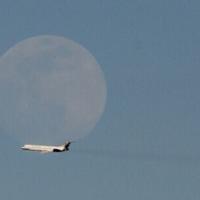

Airlines have canceled flights to and from Venezuela’s Maiquetia Simon Bolivar international airport amid warnings from the United States, which has deployed a mighty naval force off the Caribbean coast.
Carriers serving Caracas, including Iberia, TAP, Avianca, GOL, LATAM, Air Europa, Turkish and Plus Ultra have all suspended flights, while others avoid flying over Venezuelan airspace, which US President Donald Trump warned Saturday must be considered “closed.”
Panama’s Copa Airlines and low-cost subsidiary Wingo said Thursday they, too, had halted flights for two days after pilots reported interruptions in navigation signals near Venezuela.
Colombia’s state-owned airline Satena on Thursday indefinitely suspended flights over “interferences…recorded in satellite navigation systems.”
Aviation tracking site FlightRadar24 showed hardly any activity over the country Thursday, with no incoming or outgoing flights served by non-Venezuelan carriers.
Here’s what we know:
– Is Venezuelan airspace closed? –
At the end of November, US aviation authorities urged civilian aircraft to “exercise caution” in Venezuelan airspace due to the “worsening security situation and heightened military activity in or around” the country.
Then on Saturday, US President Donald Trump warned: “To all Airlines, Pilots, Drug Dealers, and Human Traffickers please consider THE AIRSPACE ABOVE AND SURROUNDING VENEZUELA TO BE CLOSED IN ITS ENTIRETY.”
The US president did not elaborate, and no formal prohibition has been issued for Venezuelan airspace, which spans some 1.2 million square kilometers (463,000 square miles) including maritime space near the US naval deployment.
In response to the precautionary flight cancellations, Venezuela’s aviation authority banned several airlines for “joining the actions of state terrorism promoted by the United States.”
Venezuelan airspace is “closed in practice,” Oscar Palma, a security expert and professor at Colombia’s Rosario University, told AFP.
Officially closing airspace usually “involves the capacity, availability, and willingness to shoot down any aircraft crossing,” he added.
“Is he (Trump) really willing to enforce this type of rule by force? We have doubts, but with the Trump administration, one never knows.”
Since September, the US military has bombed more than twenty boats in the Caribbean Sea and eastern Pacific Ocean, alleged to be transporting drugs without any evidence made public.
At least 83 people have died, many of them fishermen according to their families and governments.
– Who is still flying? –
Only four international departures and three arrivals were planned for Maiquetia on Thursday, to and from Curacao, Havana and Bogota, all operated by Venezuelan carriers.
In response to Trump’s airspace announcement, US flights of deported migrants returning home to Venezuela were initially blocked.
But days later, it reauthorized such flights at the request of Washington, which has made undocumented migration a key policy issue. A plane with migrants arrived Wednesday at Maiquetia, with another scheduled for Friday.
– Is it risky? –
Despite the lack of an official closure, “there is a risk” airlines, plane lessors, insurers and pilot unions may just not be willing to take, said a Venezuelan aviation security expert who asked not to be named.
In addition, “there is talk of electromagnetic interferences that render GPS inoperative during flight, which is a risk to consider,” he added.
jt/mbj/ba/mlr/jgc