Japan risks triggering Reeves’s next borrowing headache
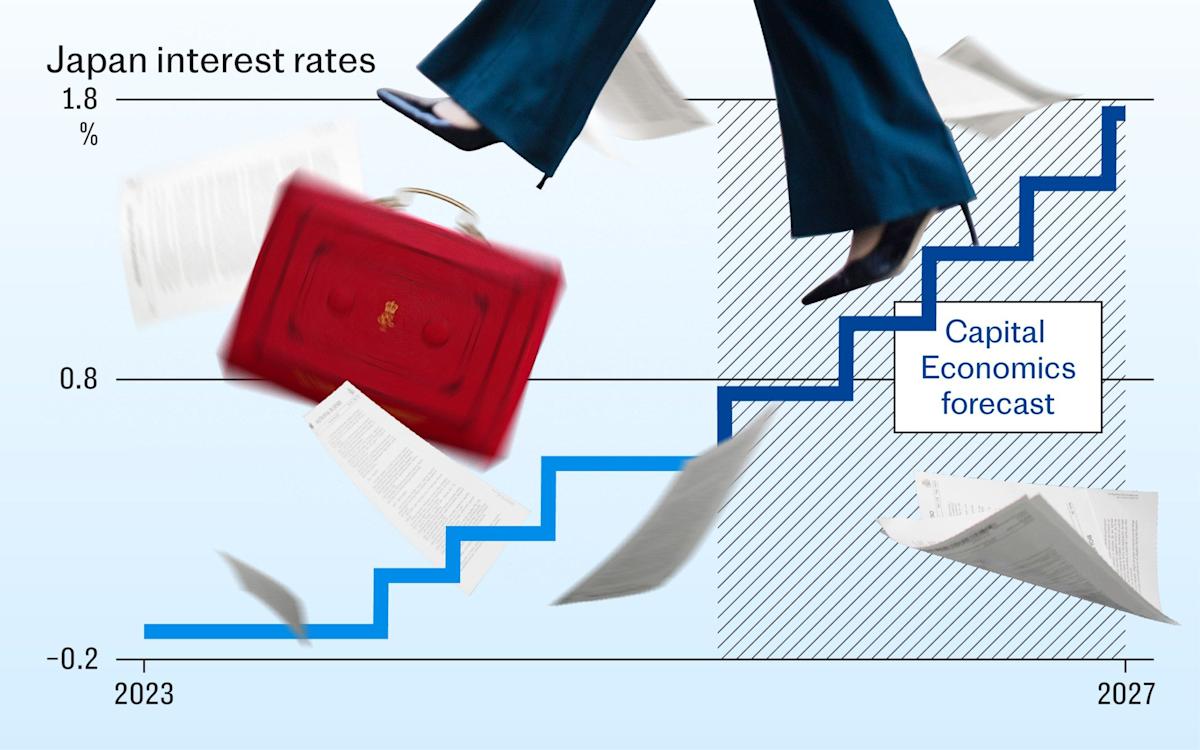
Illustration of Rachel Reeves walking down Japan interest rates chart
After weeks of attempting to get fickle bond markets on side, Rachel Reeves appeared to have finally tamed the beast.
Despite hitting households with a raft of deeply unpopular tax rises, bond investors were among the few to come away reassured by Reeves’s Budget last week.
But now events halfway around the world could be about to create a fresh borrowing headache for the embattled Chancellor.
Nerves among investors in Japan have raised fresh questions about whether UK debt costs could ramp up further in the near future. The cost of UK government borrowing has begun to creep up again after an initial drop in the wake of the Budget.
Japanese government bond (JGB) yields “have been on a tear” as markets prepare for the country’s coalition government to ramp up spending and the Bank of Japan to raise interest rates, says Kristina Hooper of Man Group, the world’s largest publicly traded hedge fund.
“It’s not just UK gilt yields we should be following closely,” adds Hooper.
“This is important because rising JGB yields can help push up the yields of other longer-dated sovereign bonds, adding to borrowing costs when some governments can least afford it.”
The potential headache for Reeves comes after Kazuo Ueda, the governor of the Bank of Japan, triggered upheaval in bond markets this week when he said he would consider the “pros and cons” of raising interest rates later this month.
Unlike the rest of the world, where central banks have been cutting rates, Japan is in the process of raising borrowing costs as it combats rising inflation. When interest rates rise, so do the yields on sovereign bonds.
Ueda’s comments on Monday wrong-footed traders who had not expected a signal that a move could come so quickly.
Money markets now indicate there is an 80pc chance the central bank will increase its key rate from 0.5pc to 0.75pc at its meeting on Dec 12, up from a 58pc probability just last week.
Derivatives trades suggest the Bank of Japan will raise interest rates twice over the next year, but some think borrowing costs could rise at a steeper pace.
“We think investors are still underestimating how far the Bank will hike,” says Thomas Mathews of Capital Economics.
Some of the reasoning for that comes from Sanae Takaichi, the country’s first female prime minister, who took office in October.
She has just passed an £88bn supplementary budget for this financial year to fund a massive stimulus package, most of which will be financed through new debt issuance.
“Looser fiscal policy will only add to the case for tighter monetary policy and we expect the Bank of Japan to lift its policy rate to 1.75pc by the end of 2027,” says Mark Williams at Capital Economics.
There is also a delicate political situation in Japan. Takaichi has a razor-thin majority in the lower house of parliament and remains short of the milestone in the upper house.
Sanae Takaichi, Japan’s first female prime minister, passed an £88bn supplementary budget to fund a new stimulus package – Kiyoshi Ota/Bloomberg
Homin Lee, an analyst at Swiss private bank Lombard Odier, said Takaichi may choose to pick her battles rather than push against rate rises by the Bank of Japan, which would strengthen its currency, the yen.
“Currency weakness has been a source of unhappiness for many voters who cite the cost of living and ‘over-tourism’ as their biggest concerns,” says Lee.
“The minority government she currently heads faces many delicate political choices ahead in terms of budgets and reforms it must deliver to avoid further political gridlock or another snap election.
“Focusing on foreign or social policy issues may be easier for Ms Takaichi than publicly pressuring the Bank of Japan to take actions that could prove unpopular with voters.”
That risks higher borrowing costs for Britain, just as the Chancellor looks like she has put the bond markets in check.
The yield on 10-year gilts had fallen from 4.51pc on the morning of the Budget to as low as 4.43pc by the end of the day. It hit 4.5pc on Tuesday after Ueda’s comments.
“Gilts are quite sensitive to broader bond market movements,” says Lloyd Harris of Premier Miton, which manages £10.2bn of client money.
Harris uses the example of former Bank of England governor (and current Canadian prime minister) Mark Carney, who once said the UK “relies on the kindness of strangers” to buy up government debt, referring to foreign investors on bond markets.
“In reality, if Japanese bonds became more attractive to other parts of the world, that means investors from all around the world will potentially start buying Japanese government bonds, and that could be taking money from gilts,” adds Harris.
“There’s a global competition for capital and in that regard the bond market is very fungible.
“It means gilts will be sensitive to what goes on in Japan, as we’ve seen earlier this week.”
And aside from the concerns in Japan, a host of other potential turmoil lurks for the Chancellor.
“2026 will raise more market concern over governance and government funding,” says Jan Lambregts of Rabobank.
“Earlier this year, that led to some wobbles focused on the US, but it’s a global theme. The Reeves Budget produced more questions than answers; Japan is boosting stimulus even as JGB yields are at multi-decade highs, the US may lean into more fiscal stimulus too and France is still struggling to produce a budget at all.”
Premier Miton’s Harris adds: “Governments just do not know how to stop spending. One of those is the United States and another is the UK.
“So the reality is that if you’re running larger deficits, you’re net issuing more bonds every year and ultimately global yields are just going to go up as a big homogeneous blob.”



Leave a Comment
Your email address will not be published. Required fields are marked *