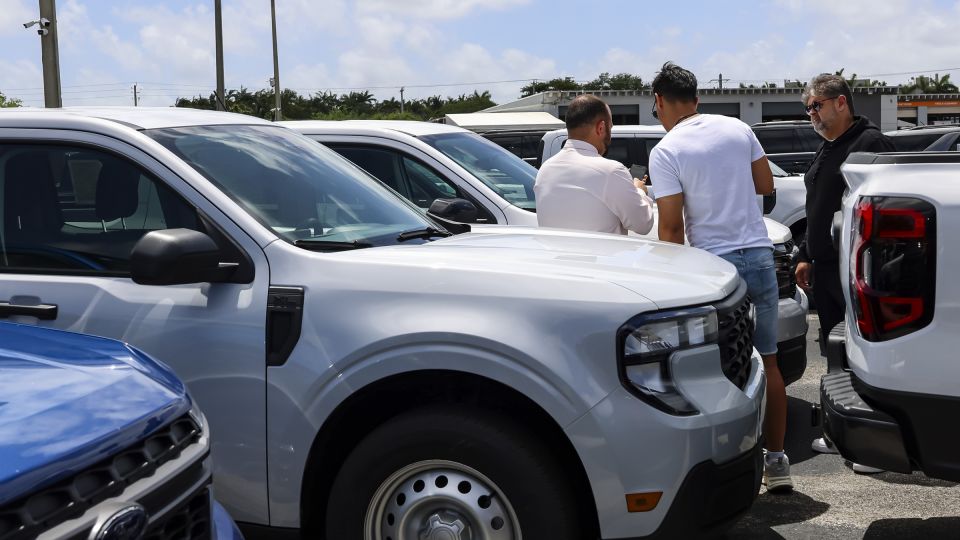
Customers browse new vehicles displayed for sale at a Ford Motor Co. dealership in Miami, Florida, on April 5. – Eva Marie Uzcategui/Bloomberg/Getty Images
Prepare for automotive sticker shock next year – again.
Average new car prices briefly topped $50,000 in September for the first time, before slipping back under that level in October.
But now, automotive experts say, car prices are headed back over that level. And this time, they might stay there.
Ivan Drury, director of insights at Edmunds, and Erin Keating, executive analyst at Cox Automotive, say cars are nearing that mark.
“It’ll edge up, even as much as the consumer doesn’t want to pay that amount,” said Drury. “It’s just the cost of everything on a car is going up, and $50,000 is just not that far away.”
The higher prices for cars – a necessity in many transit-starved cities and towns – are part of a larger affordability crisis that’s squeezed Americans, leaving many living paycheck to paycheck just to get by.
President Donald Trump, alongside top auto executives, will announce a “reset” of federal fuel-economy standards for vehicles during a White House event on Wednesday, a White House official told CNN.
Trump is likely to suggest that the action will lead to lower car prices by reducing the costs automakers accrue to meet tougher emission rules.
The CEOs of Ford and Stellantis, the European automaker that produces the Jeep, Ram and Dodge brands in the US, issued statements in advance of the event that praised the administration’s actions. But the change will do little to lower the cost of building cars.
All automakers plan their models and features years in advance, and many buyers look for improved fuel economy when shopping for cars.
Automakers also have to meet tougher mileage rules in other countries, and even some individual US states. Despite facing legal challenges from the Trump administration, many states follow strict emission rules set California.
Lastly, Wednesday’s expected change will not provide additional savings since mileage rules were essentially gutted earlier this year when legislation ended financial penalties for automakers for exceeding emission standards.
General Motors CEO Mary Barra, who was not expected to be at the White House event, said earlier Wednesday that GM would continue improving fuel efficiency even if the mileage rules are rolled back. Speaking from the New York Times’ Dealbook conference in New York, Barra added that GM would also continue to invest in electric vehicles.
No matter what changes are made to fuel-efficient rules, here’s why Americans will likely shell out more for a new car next year.
Car buyers often shop based on their anticipated monthly payment, with 80% of car sales financed, according to Experian.
Nearly a fifth of new cars now have monthly payments of $1,000 or more, Experian said, a result of a 30% increase in car prices and sharply higher interest rates since October 2019.
If the Federal Reserve keeps cutting interest rates, buys could face less in interest costs. But, perversely, that could give dealers room to increase their prices, keeping total monthly payments the same or even higher. (Anyone who’s ever bought a car likely knows the negotiating process at the dealership that ultimately determines how much a car costs.)
“Most consumers do shop by a monthly payment,” said Keating. “So I think that the monthly payment is far more impactful than anyone is giving it credit for. While affordability will still be an issue, they may feel a lot better about that monthly payment as rates go down.”
Wealthier households have also prospered in the K-shaped economy, in which higher- and lower-income households see diverging fortunes.
Stock market gains, fatter paychecks, rising home prices and anticipated tax refunds from Trump’s massive domestic policy bill could all fuel demand from richer buyers, driving sales of costlier models and pushing up average prices overall.
“This is why we believe the spring selling season is likely to be better than it’s been in typical years,” said Keating.
The end of the electric vehicle buyer tax credit in Trump’s tax and spending bill in July got a lot of attention. But the bill also quietly removed financial penalties for automakers that exceed emission regulations.
That means automakers now have greater freedom to concentrate on sales of larger, more profitable pickup trucks and SUVs – which also happen to be more expensive, again lifting average car prices in general.
Automakers have so far been reluctant to raise car prices too much and risk angering Trump, as well as potentially losing buyers to rivals.
But the average sticker price, after rising less than 3% compared to a year earlier in all but one month through August, rose about 4% in September and October, according to Edmunds. That’s because the model-year 2026 vehicles are hitting the lots, typically with higher sticker prices. Those newer models will make up an increasing share of sales going into next year as the remaining 2025 model-year vehicles are cleared out.
But there’s at least one scenario in which prices could fall – although it might be worse than higher price tags.
If the job market softens further and people increasingly lose their jobs, the bottom can fall out of the demand. Sales plunged thanks to the job losses of the Great Recession, with General Motors and Chrysler ending up with bankruptcies and federal bailouts.
No one is predicting anything that catastrophic this time. But job losses and a recession would be one very painful way to keep prices in check.
“I don’t think the headwinds predict that much of a fall,” said Keating. “I don’t think it’s waving warning flags just yet that say, ‘Hey, we’re in for a big dip.’”
– CNN’s Alayna Treene and Alejandra Jaramillo contributed to this report.
For more CNN news and newsletters create an account at CNN.com
Leave a Comment
Your email address will not be published. Required fields are marked *



Leave a Comment
Your email address will not be published. Required fields are marked *