

Why the market isn’t buying it
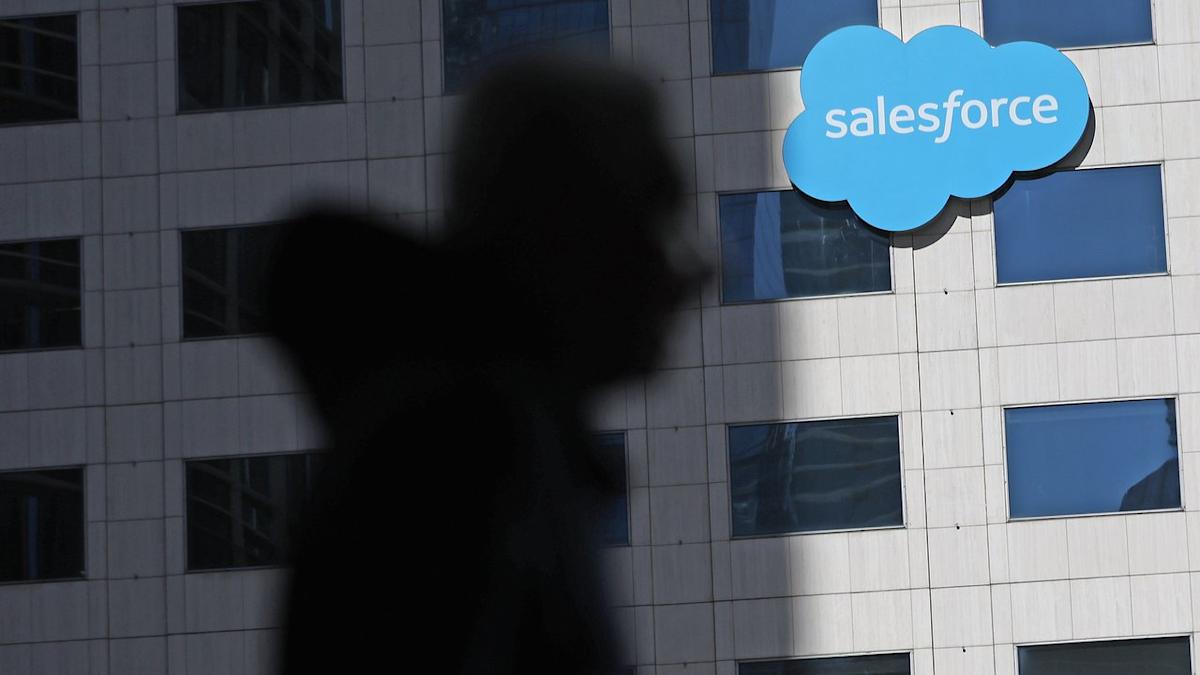
AI was meant to be Salesforce’s next growth engine, not its gravity. But as bubble fears spread and investors rethink which tech names are actually on the right side of the AI build-out, Salesforce has been pushed toward valuation levels that would have sounded unthinkable a few years ago.
Shares are down close to 30% year-to-date and sitting near the bottom of their 52-week range, even as Wall Street is still being told to expect a fresh era of double-digit growth. Salesforce’s revenue growth, which ran closer to 20% annually in the good years, is now expected to sit below 10% for the next few. And the company’s multiple has shrunk, too: The company’s forward P/E is now around 18, trading at about five times forward sales, a steep comedown and below where many large software peers still sit.
The market is pricing Salesforce like a slightly above-market plodder, not a company that spent the last year-plus shouting about AI agents and its reaccelerated growth curve.
The company reports its latest earnings Wednesday after the bell, and the Street is expecting a modest beat — revenue of roughly $10.27 billion and non-GAAP earnings around $2.86 per share, up roughly 9% and 18% year over year, respectively. But Salesforce’s bar is less about hitting numbers everyone has already penciled in and more about whether the company can change its story.
Investors are sizing up whether Agentforce and Data Cloud — last disclosed at a $1.2 billion ARR run-rate — can really start to matter. If Salesforce just delivers “business as usual,” the stock may bounce. If it delivers evidence that AI is finally moving the needle — real attach rates, widening adoption, a trace of an AI-rich future — then maybe this derated cloud giant starts looking like a mispriced AI sleeper instead of a fading tech relic.
Salesforce’s AI-story disconnect starts with the chart and ends with the chatter. On one side is a company telling investors it can wring more than $60 billion in annual revenue by the end of the decade with AI, data, and automation doing most of the heavy lifting. But on the other side is a stock that is shedding value and trading at the thinnest valuation in its public life because a lot of people now hear “AI” and think “bubble,” not “runway.”
Nvidia and the hyperscalers are still being cast as the arms dealers and landlords of the AI boom. But there’s a growing bucket of software names that are being marked down on the theory that AI is going to eat their lunch, their contracts, and maybe their entire category. Salesforce has become the poster child for that second group. MarketWatch has literally put it in its “AI loser” camp, while Barron’s has warned that Salesforce’s earnings are unlikely to “dispel fear that AI could hurt it.” Even a solid quarter reported Wednesday is unlikely to resolve the central worry circling Salesforce: that AI could compress software pricing, redirect budgets toward infrastructure, or make it easier for entrants to displace incumbents.
Leave a Comment
Your email address will not be published. Required fields are marked *