
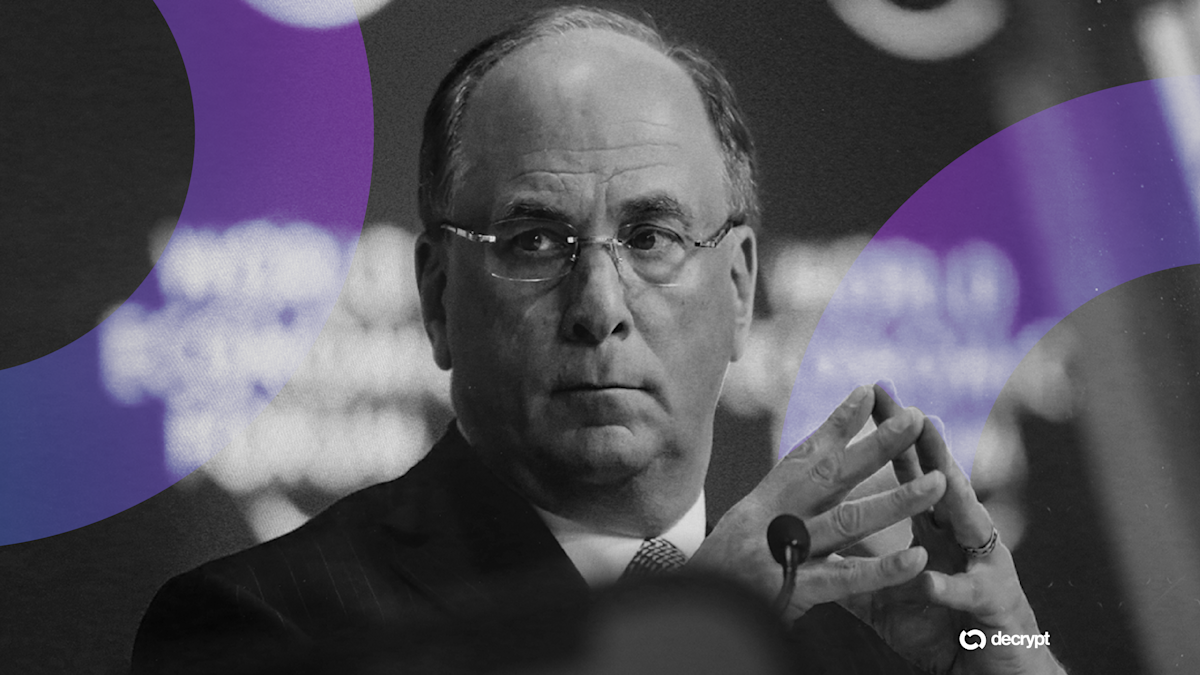

BlackRock’s Fink and Goldstein Say Tokenization Could Redraw Market Plumbing
BlackRock’s most senior executives say the financial system is on the cusp of its biggest infrastructure overhaul since the arrival of electronic messaging in the 1970s, one driven by blockchain-based tokenization.
In a new column for The Economist, BlackRock CEO Larry Fink and COO Rob Goldstein say that finance is “entering the next major evolution in market infrastructure,” one that could move assets “faster and more securely than systems that have served investors for decades.”
Tokenization records ownership of assets on digital ledgers, enabling stocks, bonds, real estate, and other holdings to exist as verifiable digital records that can be traded and settled without traditional intermediaries.
The executives’ view fits squarely within BlackRock’s tokenization agenda, harking back to Fink’s 2022 statement that “the next generation for markets, the next generation for securities, will be tokenization of securities.”
“At first it was hard for the financial world—including us—to see the big idea,” the duo wrote, noting that tokenization “was tangled up in the crypto boom, which often looked like speculation.”
But beneath that noise, “tokenization can greatly expand the world of investable assets” and “offers the potential to settle transactions instantaneously,” while replacing “manual processes, bespoke settlements and records that haven’t kept up with the rest of finance.”
The world’s largest asset manager’s executives did caution that the technology won’t replace existing systems immediately, describing it instead as “a bridge being built from both sides of a river” connecting traditional institutions with digital-first innovators.
Global Exchanges Urge SEC to Curb Broad Crypto Exemptions, Warn on Tokenized Stock Risks
Joshua Chu, a lawyer and co-chair of the Hong Kong Web3 Association, told Decrypt that BlackRock is “probably directionally right that tokenization will be part of the ‘next generation for markets,’ but the implied timing is, in my view, potentially over-compressed.”
“This is a multi-cycle transition in which narrow, well-regulated use-cases will accrete over time, not a one-cycle revolution where everything is tokenized by next year,” Chu said. “That is simply not how innovation works.”
‘Tokenization absolutely has a place in modern finance,” he said, but stressed it “only earns its keep when it solves a real problem that a plain-vanilla structure cannot,” whether by reducing settlement risk, improving collateral mobility, or opening access to previously unreachable assets.
Leave a Comment
Your email address will not be published. Required fields are marked *